
PR Pricing: A guide for buyers
PR Pricing: A complete guide for first-time buyers
Having been in this industry a long time, I often hear the same questions, hesitations, misunderstandings, and concerns arise from first time PR buyers. By the time they reach me, most are aware that they need to increase their visibility and credibility in a way that standard marketing just can’t do, but they don’t know where to start. They have a meaningful story, a product/service that sells, and a valuable offer that they want to get in front of a larger audience. In this case, incorporating PR is a smart decision, since leveraging trusted third-party voices works to amplify a narrative, build trust, and improve industry positioning.
In fact, studies show that 64% of buyers say a company’s thought leadership content is more trustworthy than its marketing materials, and nearly half have decided to do business with a brand based solely on strong thought leadership (LinkedIn & Edelman, 2023). Additionally, 70% of people trust a company more after positive media coverage and 81% of consumers say they must trust a brand before buying. Considering these statistics, it’s hard to negate the importance of PR, particularly on a growing company.
While you may understand the value of PR, if you don’t know what to look for, it would be easy for some smooth-talking PR rep to sell you on something you don’t need or make grandiose promises that are not in your best interest just to get the contract. So then how do you know if you are making a smart decision or dumping your money into a worthless endeavor?
My intention is to provide the clarity and insight that you need as a new buyer to make a well-informed decision. Thus, this guide will help you determine what you actually need, how much you can expect to pay for it, how to hire for best results, and the estimated timeframe it will take to get there.
The PR industry at a glance
The PR industry has changed a lot over the last few decades. Not just with the rise of AI, though that does have a dramatic impact on the future of the industry and how work is implemented now, but more consideration is given to where you show up and how. Long gone is the idea that “Any publicity is good publicity,” and media placements on their own aren’t always enough to move the needle. A good example of this is the beauty industry – no longer does one Marie Claire article about your face cream drive people to action. Consumers are looking to AI to determine what is worth their time and money, while brand summaries, which assess sentiment across earned, paid, owned, and shared content, are the driving force behind how AI develops an overall narrative.
This also means that publications that would have otherwise been considered worthless 10 years ago have become increasingly valuable now, such as blogs, Substacks, podcasts, and newsletters. Add in the shrinking size of newsrooms, and huge competition for story coverage (with fewer reporters to target) and you have a recipe for new emerging trends and best practices.
So, what does that mean for you? Well… a couple things. First, it means that hiring an experienced professional that can navigate the current industry landscape is increasingly valuable (I have spoken out extensively about the true cost of doing business with cheap PR firms/freelancers). Second, it makes it a little trickier for internal teams to successfully implement PR campaigns on their own, because sending out a standard press release isn’t as powerful as it once was. The fact is, PR today has to be skillful, nuanced, and highly strategic. So what does it look like when you bring in a PR professional and what do they actually do for you?
PR Behind the Scenes
This is probably the part that I spend the most time explaining to new clients, because without transparency, it would be easy to assume the only work is emails and press releases. In reality, there is a lot that goes on in the back end to prepare for a successful campaign, and even more once the campaign is underway to ensure momentum progresses steadily. For instance, when we bring in a new client, we immediately research potential opportunities, develop a comprehensive pitching profile with bios, angles, narratives, and assets, outline strategies and tactics, create media kits, and establish media contact lists before we even begin outreach to reporters.
The point behind all this work is to make sure that we can get initial momentum (Think within the first 30 days) and also pivot as the campaign progresses. Since we utilize a proprietary approach, we find that the best campaigns involve simultaneous multi-platform and multi-angle pitching, but any PR firm would utilize a variety of tactics designed to align with your unique business goal. This could include any variation of:
Brand Awareness and Positioning – Leveraging brand offerings, services, internal happenings and aligning them with market trends and current conversations
Corporate Communications – Announcing change at leadership, new hires, acquisitions, sales, funding rounds, expansions, or partnerships
Thought Leadership – Expert commentary, subject-matter expert coverage, podcast/conference speaking gigs, opinion editorials, market insight interviews
Accomplishments and Events – Notable achievements, award announcements, public/media events, press conferences, day-of event outreach
New Product/Service Launches – Pre-launch coverage, post-launch interviews, third-party media reviews, partnership promotions
Content/Messaging Development – Press releases, media pitches, talking points, boilerplate statements, narrative development
Monitoring and Reporting – Message penetration, estimated number of views, domain authority, shares, sentiment analysis, success metrics
Partnerships and Collaborations – Research, applications, and outreach for third party promotion/publicity opportunities, meaningful collaborations, and partnerships with industry experts.
Crisis Communications – While this is the largest part of what we do, it is usually separate from a standard PR retainer and can include reputation management, specialized interviews, message/statement development, fast coverage, and immediate placements
Depending on your goals, a PR firm should be compiling those that would be the most impactful and relevant to you. Case in point, when a client came to me with a new children’s book, no previous publicity, no online awareness/presence, and no user reviews, we had to start from scratch building an awareness campaign. This was made more difficult by the fact she wanted no thought leadership (I wasn’t allowed to highlight the creators, their inspiration, or why they created these books) and we couldn’t leverage market trends or insights. So we utilized a mix of third-party influencers and collaborations, events, and partnerships to get her off the ground.
Difference between small and large PR firms and where to start?
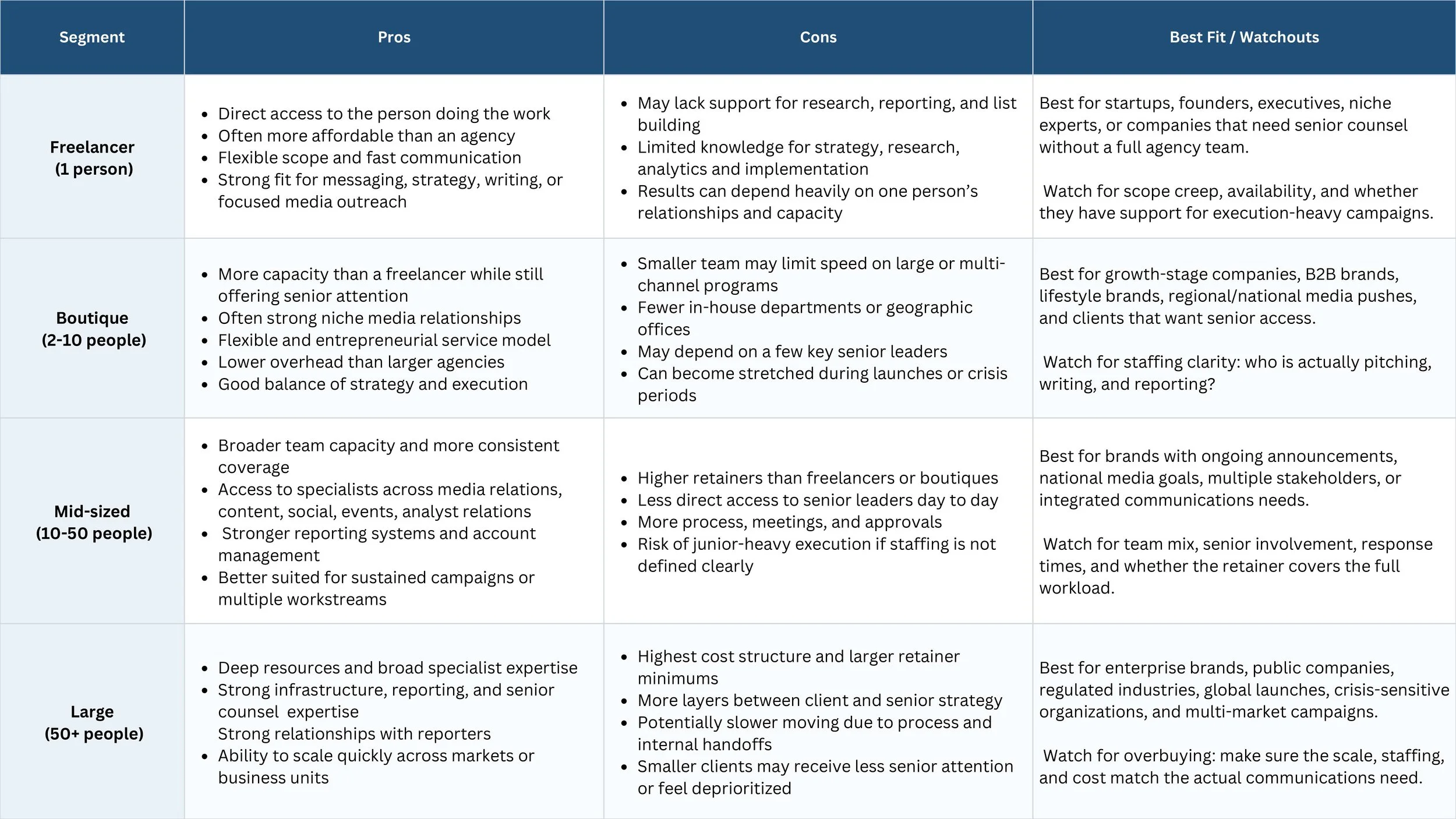
Not every company has the same needs, so the option you choose should match where you are versus where you want to be, how long you can afford to budget in PR, and what level of support you are likely to require. While size does not automatically determine quality, you should be aware that the right PR partner depends on scope, industry knowledge, media goals, senior involvement, and whether the team’s capacity matches the expected workload.
Here are the most common options, along with their pros, cons, and who they are a good fit for:
Expectations in price points and why they vary
The #1 question we hear day in and day out: “Can I see your packages and price breakdown?” … to which I respond, “We have no such thing.” This is because the cost of each campaign will vary based on scope, timeline, project details, goals, needs, and complexity. As frustrating as it is to have to go into a meeting with me first to figure out if there is going to be insane stick shock, PR pricing is just not one-size-fits-all.
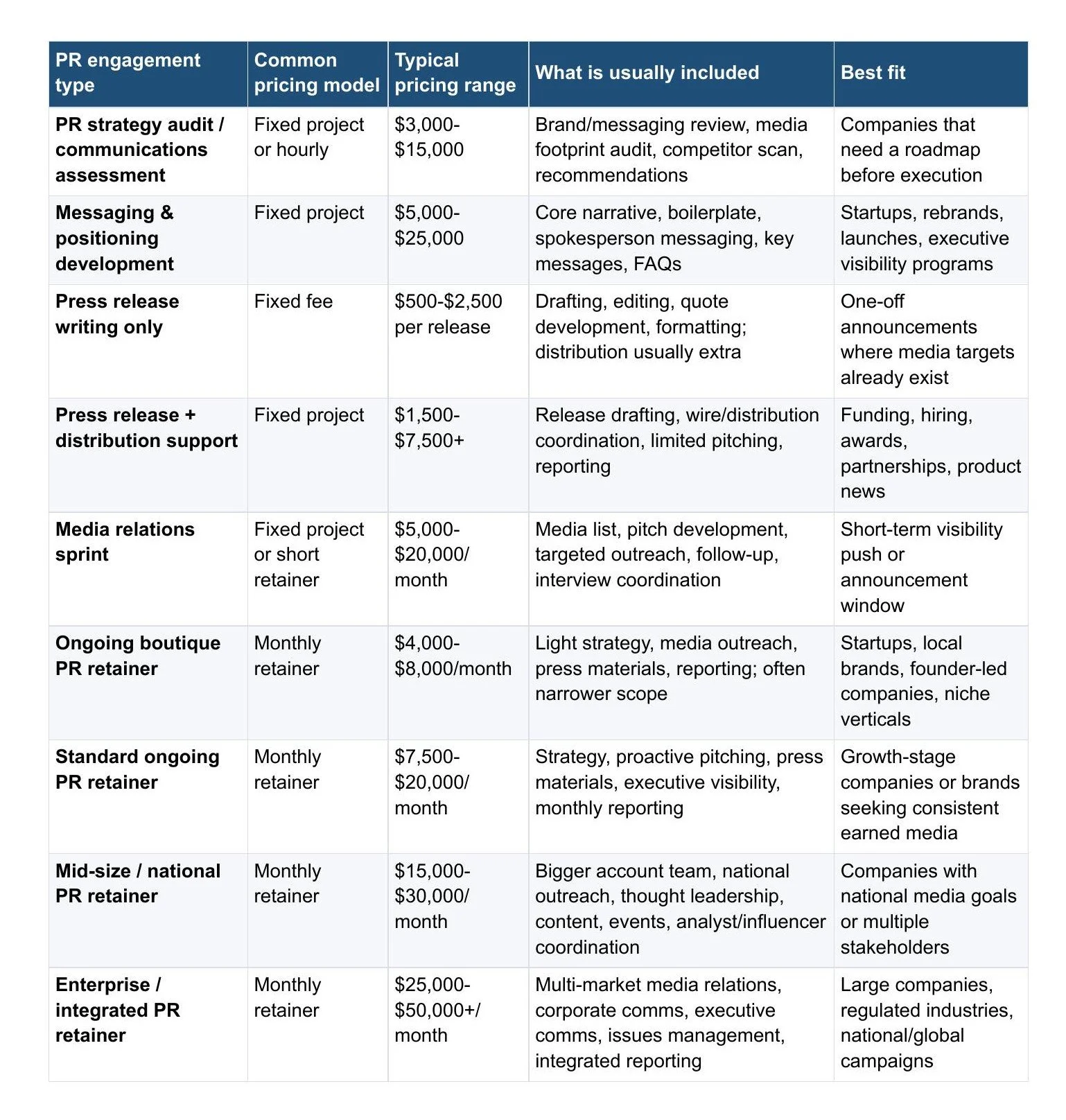
A $5,000 monthly retainer and a $25,000 monthly retainer may both be reasonable, depending on scope, seniority, speed, industry complexity, and the level of media outreach required. The most transparent PR proposals explain not just the fee, but what team provides, including deliverables, response times, and success metrics.
The following is a general rule of thumb if you are pricing out potential PR services and what you would expect to pay. While budget is always a concern, it should never be the sole influence in deciding who to hire. If that were the case, everyone would at some point get burned by cheap PR alternatives.
These are typical U.S. market ranges, not guarantees:
No Matter What You Choose, It’s Going to Take Time
No PR firm worth their salt is going to tell you they can guarantee coverage. Why? Because guaranteed coverage also equals paid placements, which are usually filed away in inaccessible parts of a website where no one would ever organically read. They are also typically label for what they are as “Sponsored content” or “Contributor placements” letting people know that it was paid for. Plus, they live on the platforms for no longer than 12 months. Want to see what it looks like after 12 months?
These tactics don’t build trust or move the needle, although many firms operate solely on selling this very type of publicity. In order to build real momentum and media coverage that moves the needle, you must be willing to commit 6 to 12 months.
Back when I first started, I used to do 30-day campaigns. Those were both hair-tearing and widely inefficient, since a successful campaign can get nothing done in that time frame. Then I moved to 3-month minimums, and again I realized it was doing a great disservice to clients. This is because if you are investing $4500 per month and finally start seeing momentum and results, who is it really hurting to pull the plug when things are getting good? The answer is both parties… our time and energy went in to something that gets abandoned, and the client never sees the full potential of these efforts despite their financial investment.
So, 6-months became the minimum for standard PR campaigns. In our experience, this is the exact amount of time where publications, podcasts, and interviews start going live, we can leverage them for more placements, we have more metrics and analytics to work against, and we can pivot when things aren’t working (Or alternatively we have more time to track and jump on immediate opportunities).
Transparency: In some cases, project-based initiatives or crisis situations can get away with a 3-month timeline (Although for crisis, I typically recommend 6 because of the unknowns that can pop up).
For instance, things like announcing a new CEO, discussing an upcoming hiring push, promoting investor funding or raise, or any other quick bursts of information can be done within a 3-month timeframe. But also consider this – once your company has publicity momentum, its often easier (and you get better results) if you can keep that going.
In Summary
PR is one of the most powerful tools a growing company can use to build credibility, visibility, trust, and long-term authority, but only when it is approached strategically. The most successful PR campaigns are not built on generic press releases, guaranteed placements, or vague promises, but on clear messaging, thoughtful positioning, strong media strategy, consistent outreach, and a realistic understanding of what it takes to create momentum.
For first-time PR buyers especially, transparency matters. Understanding the difference between a freelancer, boutique agency, mid-sized firm, or large agency can help you choose the level of support that actually matches your goals, budget, and internal capacity. Likewise, knowing how pricing typically works across audits, messaging, media relations, retainers, launches, and crisis communications can help you avoid both overpaying for unnecessary services and underinvesting in work that requires time, experience, and strategy.
The biggest takeaway is this: PR is not a quick fix. It is a long-term investment in meaningful reputation building that requires a longer-term commitment. When implemented correctly, it does more than generate coverage, but shapes how your company is perceived, strengthens your industry position, and creates third-party validation that marketing alone often cannot provide.
At Evolved PR, we believe in empowering our clients through education, awareness, and insights that can improve collaboration and make the campaign more successful down the line. If you still have questions on your own particular scenario that this guide did not cover, feel free to reach out and we can assess your situation for free.
Reach out to us to start a conversation about what PR could look like for your brand.
